The COUNT ME IN PROJECT
A patient-partnered initiative to accelerate LMS research
The International LMS Research Roundtable is in its 6th year of collaborative success to move research forward in a unique way - with four workgroups focused throughout the year, reporting each and every year on current progress to the Roundtable membership. Working with MD Anderson is an added bonus, along with CURE ID for Repurposed Drug initiative collaboration with the NLMSF:
RESEARCH SAVES LIVES!
SURVIVORSHIP IS IMPACTED!
The National Leiomyosarcoma Foundation is partnering with Count Me In to inform patients about this exciting project and to encourage them to participate at NO COST. The Count Me In LMS project is a non-profit initiative, bringing patients and researchers together to accelerate discoveries in cancer research. The LMS project is a database / natural history database, supported by a grant from the National Cancer Institute. For more detailed information: www.lmsproject.org
New Development - Now in 2024 for Uterine LMS
Learn more updates on the CMI - NLMSF Uterine LMS Pilot Program that needs direct patient advocacy along with the regular Count Me in Project - both are important to learn more about / ask questions.
Update: LMS Project Webinar (Count Me In) — 2025
Dr. Suzanne George and the CMI LMS Project team share updates on the LMS Project, the uLMS pilot, and the collaboration with the NIH LMS SPORE program. NLMSF has co-funded support for the past 4 years and continues to do so.
RARE CANCER RESEARCH FOUNDATION / Pattern.org
Research Matters / Research Saves Lives!
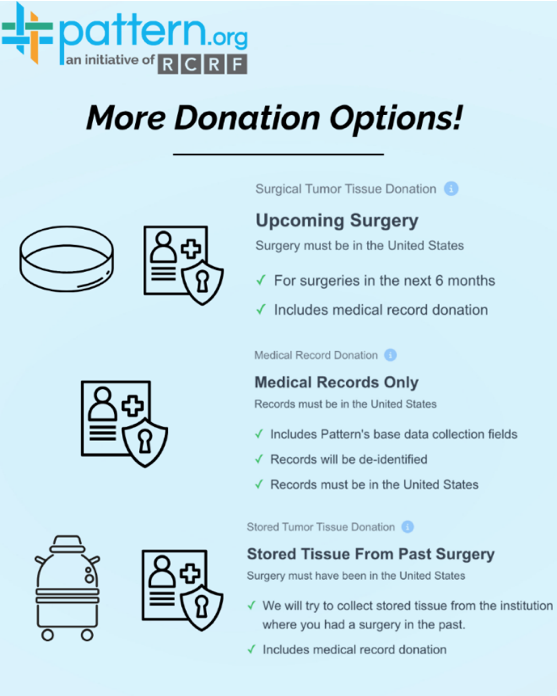
The Rare Cancer Research Foundation and the National Leiomyosarcoma Foundation joined forces in 2017 to offer patients the opportunity to advance research through their decision to donate tumor tissue ahead of a scheduled surgery to extract the LMS tumor.
Pattern.org is the patient powered platform empowering patients to advocate for the acceleration of research initiative through contributing tumor tissue samples, where clinical data will be derived for global research access - note: de-identified clinical data.
"By contributing your tumor tissue through a surgery, biopsy, or fluid drain you make it possible for researchers to make a working copy of your cancer type that will continually grow in a laboratory. This copy is called a "model" and it makes it easy for researchers to study your cancer type and test treatment ideas. Simply put, by sharing your tumor tissue, you make it possible for researchers to make faster progress on critical cancer research."- Pattern.org
Improving patient outcomes and advancing not only research, but survivorship of leiomyosarcoma is the goal of patients directly impacting research in this way.
Pattern.org is a revolutionary platform through the Rare Cancer Research Foundation, with the highest standards of privacy and security, that empowers patients to donate de-identified live tumor tissue samples and clinical data directly to the global research community – to enable researchers to:
- have more information about the disease
- more tools and resources to amplify data
- enhance informed treatment decisions
An LMS Biobank is established:
- to break down silos of institutional biobanks that fracture data collection efforts
- to build a shared resource across the country for the LMS Patient Community
- Data harmonized across leading sarcoma centers of excellence creates an open source data commons
- Create the ability to explore Repurposing Drugs research for LMS
This revolutionizes the ability to promote rapid advancement of scientific discovery!
TOGETHER WE CAN ALL COME TOGETHER TO ACCELERATE LMS RESEARCH, ADVANCE LMS TREATMENT OPTIONS, AND ENHANCE SURVIVORSHIP!
CURE ID PATIENT INFORMATION TOOL KIT
help researchers identify drugs for repurposing in the treatment of LMS

CURE ID REPURPOSED DRUG TOOL KIT FOR PATIENTS
The Repurposed Drug Initiative
The NLMSF in collaborative partnership with CURE ID, will be launching the Repurposed Drug initiative for Leiomyosarcoma patients to participate for a patient registry of de-identified data that will be analyzed against drugs approved by the FDA. This promotes the potential for advancing new treatment options for LMS.
Drug repurposing refers to the identification of clinically approved drugs with the known safety profiles and defined pharmacokinetic properties for new indications. Despite the advances in oncology research, cancers are still associated with the most unmet medical needs.
Tumor biomarkers associated with the different outcomes, such as the anticancer response or toxicity, can be used in the future, together with a patient's genetic profile, to personalize their treatment.
Read this Nov. 2023 article on the topic in the British Journal of Cancer: Unlocking hidden potential: advancements, approaches, and obstacles in repurposing drugs for cancer therapy.
CURE ID Resources
- Guidance from CURE ID for the Repurposing Drug Initiative Partnership with the NLMSF: Open guidance document
- How-to guide: https://cure.ncats.io/resources/guides
- FAQs and Videos (see Case Report Demonstration Videos → Rare Cancers (Sarcoma)): https://cure.ncats.io/resources/faqs
The NLMSF has also launched a complementary LMS Workgroup for Repurposed Drugs using Leiomyosarcoma cell line (from tumor tissue) processing — for drugs approved by the FDA for drug response exploration. This initiative includes collaborative partnership with: the Fred Hutchinson Cancer Center, MD Anderson Cancer Center and UMass General in Massachusetts.
Such research has great potential to help ANY SARCOMA SUBTYPE IN THE FUTURE.
More information on the CRDC/NLMSF program will be forthcoming in late April and the platform finalized in May, along with an information video from CURE ID. Preliminary information here... or contact annieachee@aol.com.
PATIENT-DRIVEN RESEARCH Initiatives
Pattern.org
In 2017, the Rare Cancer Research Foundation (RCRF) joined forces with the National Leiomyosarcoma Foundation. Through RCRF's patient-driven initiative, Pattern.org, leiomyosarcoma patients can contribute directly to groundbreaking LMS research. There is a transformative impact of tissue donation on rare sarcoma research and patients play a crucial role in this process.
Participating is simple - just make the decision to provide your consent before your surgery through Pattern.org. By agreeing to donate your excess tumor tissue at Pattern.org before your scheduled surgery, you can significantly contribute to advancing research on Leiomyosarcoma (LMS). Your tumor tissue will be sent to MIT's Koch Institute, specifically the Boehm Lab, led by Dr. Jesse Boehm, the Principal Investigator. The lab's primary focus will be on genomics and cell line model development for leiomyosarcoma, and all research findings after de-identification will be made available to researchers globally.
As a patient, YOU can become an integral contributor to furthering rare cancer research through initiatives like Pattern.org.
For any questions about this program, contact Barbara Van Hare, President of Pattern.org. She will be happy to answer all questions or possible concerns so that you feel comfortable with participating in this GIANT step forward for global LMS research:
Email: barbara@rcrf.org / Phone: 844-472-7273 extension 700.
THE COUNT ME IN LMS PROJECT
Count Me In Gives LMS Patients a Way to Impact Future Treatments
YOU can help accelerate new treatments for LMS!
In early 2022, we will have a greater impact in our future through a project called Count Me In. This non-profit organization will collect samples and information from anyone who has ever had LMS in the United States and Canada—with appropriate privacy protections—and release the anonymous data publicly so that researchers can share their ideas on new, more effective ways to treat LMS.
All you do is sign a consent and the rest is taken care of!
Count Me In started in 2015 as a project run by the Broad Institute and Dana-Farber Cancer Institute (which has a sarcoma center) for metastatic breast cancer patients.
Here is what The Leiomyosarcoma Count Me In project will do:
- Ask LMS patients in the United States and Canada to submit samples of their tumors so they can undergo molecular and genomic research at the Broad Institute.
- Use this research to produce a large set of data that can be provided to researchers. Because LMS is so rare, this data will first help researchers to gain a better understanding of the disease—then expanded knowledge to work on better treatments.
- Provide you information about your individual data AT NO COST (available for patients who live in the United States, except New York; not available for Canadians).
"We've been working closely with a committee of 10 LMS patients and caregivers to provide input and feedback on the project design. As the project launches and gets going, we will have more opportunities for members of the community to get involved with providing feedback and input on the project and we will share those as they're available. After we launch the project in early 2022, participants can provide questions or comments on their experience in the project through surveys and reaching out to the team."
- Taylor Custer of Count Me In
Patients will have two chances to learn more about their DNA from the project, one for tumor DNA and one for germline or normal DNA.
"If a participant elects during the consent process to share archive tissue samples with the project and the tumor sample is successfully sequenced, we can share information from the genomic sequencing of the tumor sample back with the participant. Participants can choose whether or not to receive this information about their tumor sample during the consent process. The information about a participant's tumor is intended to highlight how participant sample(s) are contributing to research and will not have implications for their treatment or prognosis,"
Cusher explained
However, regulatory restrictions prohibit the sharing of results with participants in New York and Canada.
"The project is also partnering with Invitae in order to sequence and share information on germline DNA (or "normal" DNA) from saliva samples. During the project, participants will be able to decide if they would like to provide an additional saliva sample to learn more about their normal DNA and speak with a genetic counselor to understand these results,"
Cusher added
"If a participant chooses not to participate in this process, the data will not be shared with Invitae. This process is not available for participants in Canada, as Invitae is not licensed to provide genetic counseling services there."
More information on the Count Me In model and other projects can be found at joincountmein.org.
To make sure you are notified about when you can sign up, go to https://joincountmein.org/lms.
Need more information? The Count Me In staff welcomes questions and comments through email at info@lmsproject.org.
Great News!
As you may remember late last year the Broad Institute (a joint Harvard and MIT research institute) agreed to add Leiomyosarcoma patients to its Count Me In Project.
The Goal of the Count Me In Project is to partner with patients with leiomyosarcoma around the United States and Canada in order to study their cancer using cutting-edge genomic and molecular research studies performed at the Broad Institute, and to leverage technology to allow patients to participate in these studies regardless of where they are treated.
They will generate a large dataset that includes genomic, clinical, molecular, and patient-reported information that can be shared with the biomedical community in order to accelerate discoveries and better therapies for this disease. Cancer is not a single disease, and each medical record, tumor, and patient's story holds part of the puzzle. Our goal is to help the research community better understand the landscape of leiomyosarcoma and accelerate discoveries by making data more readily available.
In addition, the Count Me In Team will study approaches to engaging with the LMS community and work directly with patients to improve our methods. We will focus on hearing from groups that have been historically left out of research, like rural and underrepresented participants. What we learn together will help improve future patient-partnered studies and increase the diversity of patients we partner with in an evidence-based way, to ensure that new insights are relevant to and benefit as many patients as possible.
The LMS-specific COUNT ME IN project has just created a webpage https://joincountmein.org/lms with more details about the project which is going to start enrolling patients in early 2022. There is a button on the webpage where patients can sign-up to be notified when they can enroll in the project.
This a great opportunity for all LMS patients to participate in a project that has great potential to help improve the understanding of our tumor and lead to more focused basic science and translational research with the goal of developing more targeted treatment options for LMS patients and hopefully improved survival.
We encourage all LMS patients to take advantage of the opportunity to participate in this groundbreaking project.
Mitchell D. Achee, M.D.
COUNT ME IN Patient Advisory Committee
National Leiomyosarcoma Foundation Representative
Who Can Join?
If you've ever been diagnosed with LMS, you can join the LMS project by sharing your samples, copies of your medical records, and your experiences. Information collected and shared will be de-identified before being shared widely with researchers to speed discoveries. All patient information is de-identified.
How Do You Participate?
You participate by giving the project permission to obtain your medical records, saliva, blood and stored tissue samples, and providing information about your personal LMS journey. Click here to learn more...
By consenting to share tumor tissue, ahead of a scheduled surgery, patients can make a real impact. De-identified tumor tissue will be sent to Dr. Jesse Boehm, head of this research initiative at the Koch Institute of MIT and Barbara Van Hare, Director of Patient Research and Advocacy Liaison, to help scientists develop next generation cancer models, which will be made widely available to the research community. Using these models, researchers can identify cancer's key points of vulnerability and accelerate drug development.
Contact Annie Achee at 303-808-3437 for details. The RCRF website: https://rarecancer.org/